
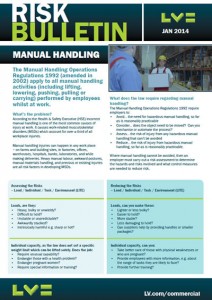
 The Manual Handling Operations Regulations 1992 (amended in 2002) apply to all manual handling activities (including lifting,lowering, pushing, pulling or carrying) performed by employees whilst at work.
What’s the problem?
According to the Health & Safety Executive (HSE) incorrect manual handling is one of the most common causes of injury at work. It causes work-related musculoskeletal disorders (MSDs) which account for over a third of all workplace injuries.
Manual handling injuries can happen in any work place – on farms and building sites, in factories, offices, warehouses, hospitals, banks, laboratories, and while making deliveries. Heavy manual labour, awkward postures, manual materials handling, and previous or existing injuries are all risk factors in developing MSDs.
What does the law require regarding manual handling?
- The Manual Handling Operations Regulations 1992 require employers to:
- Avoid… the need for hazardous manual handling, so far as is reasonably practicable
- Consider… does the object need to be moved? Can youmechanise or automate the process?
- Assess… the risk of injury from any hazardous manual handling that can’t be avoided
- Reduce… the risk of injury from hazardous manual handling, so far as is reasonably practicable.
Where manual handling cannot be avoided, then an employer must carry out a risk assessment to determine the hazards and risks involved and what control measures are needed to reduce risk.
To read the full Risk Bulletin from LV Commercial view the PDF below:

